The Difference Between Coaching and Telling
May 25, 2026

The Difference Between Coaching and Telling
There's a difference between teaching someone what to do and actually changing how they think. One of them is coaching. The other is just expensive telling.
I know a lot about cold outbound. My background is as an SDR at a small SaaS business, then at Google, then at SalesLoft. I've written a lot of cold emails. Like, a LOT. I know what tends to work and what tends to get ignored, and for a long time I thought that was the job. Learn the frameworks. Write better emails. Get more replies.
Then I became a coach, and I had to start thinking about something more complicated: why would someone know exactly what to do and still not do it?
Because that happens all the time! You share the framework. The rep understands it. Agrees with it. And then gets on a call or opens a laptop and goes back to exactly what they were doing before. Something is getting in the way, and it's not knowledge.
Without an OMG assessment, without an X-ray, I don't know what I'm targeting.
Could it be a high need for approval, making their tone submissive, writing emails that sound nice rather than challenging a prospect's assumptions? Could it be a belief that the more information they give, the more likely someone is to respond? Could it be a subconscious fear of rejection that's making them optimise for silence rather than a clear no?
That's the difference between coaching with an OMG result and coaching without one. Without it, I'm guessing. With it, I know exactly where to start.
What the process actually looks like
When I get OMG data back on an SDR, the first thing I do is go through it properly before we speak. I'm looking for patterns. What's the story this data is telling me? Where are the mindset challenges? How are the Will to Sell scores sitting relative to the DNA scores?
Then we do a proper one-hour evaluation session together. Not a debrief where I read out scores at them. A conversation.
Where are they in their career?
What do they actually want?
What's working and what's frustrating them?
That context is everything. The data makes more sense when it's next to the person.
Out of that conversation, we build a coaching plan. Not a training plan - a coaching plan. The difference matters.
Training gives people information. Coaching changes behaviour.
The only way you change behaviour is: challenge the belief, implement an action that challenges it, and then reinforce the benefit of the new action until it becomes a new belief. That cycle, repeated, is what coaching actually is. Anything else is just instruction.
The research is pretty unambiguous on this. According to MySalesCoach's 2026 State of Sales Coaching data, SDRs who receive frequent, high-quality coaching are 30% more likely to hit quota than those who receive little or none. 3 in 4 SDRs who receive frequent, high-quality coaching feel fulfilled in their role, compared to just 1 in 4 who receive little or nothing.
Coaching works. The question is whether you're doing it on the right things.
The three tactical scores that matter for SDRs
The OMG assessment doesn’t differentiate between SDR and AE, it asks the same questions of all sellers. As a result, some of the questions and some of the 10 tactical competency scores may not feel relevant to you when you receive the results.
I want to talk through the three OMG tactical competencies that I actually care about when coaching SDRs, because they're not the obvious ones, and they're often misunderstood…
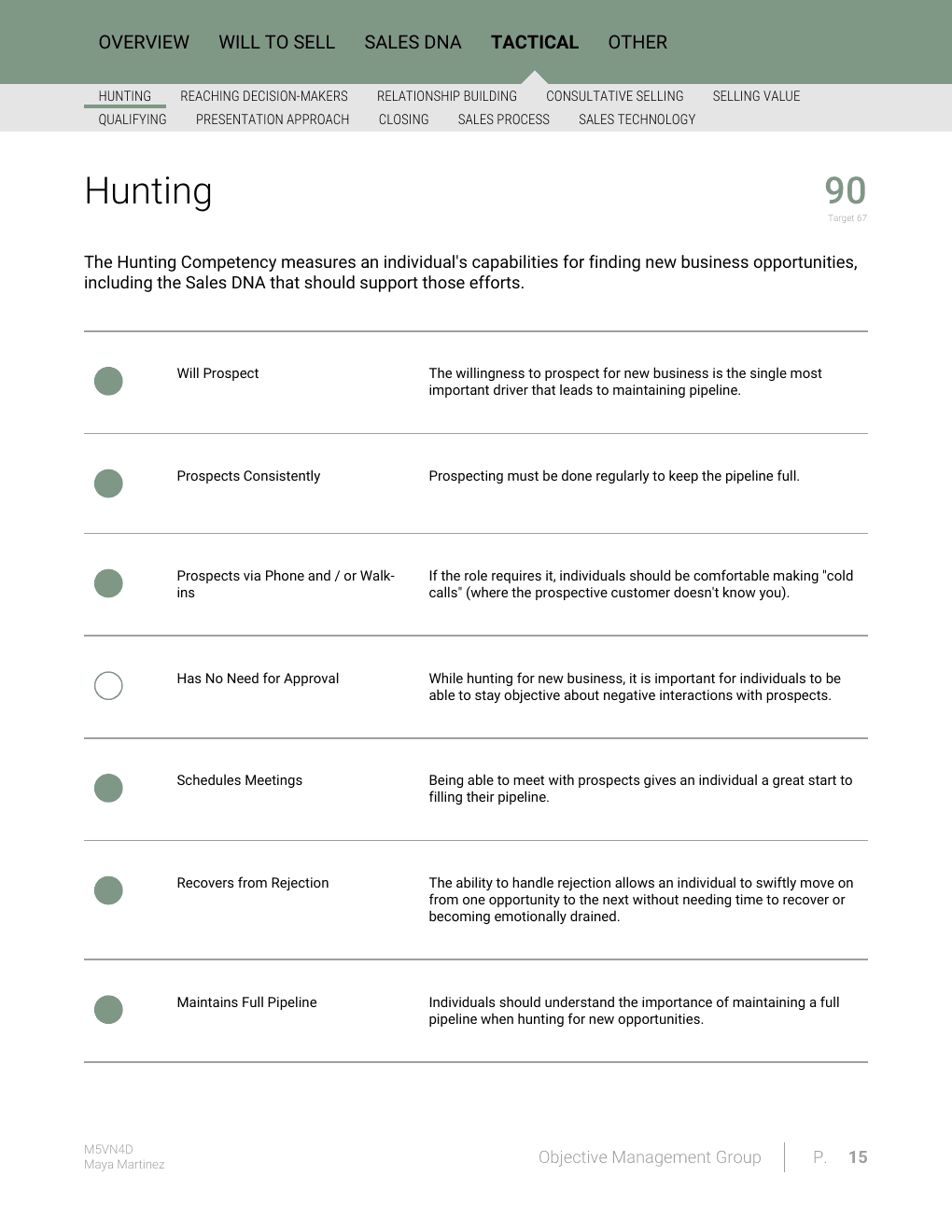
The Hunting competency breakdown from a sample OMG report. Note it measures disposition and behaviour, not just booking ability. All data is dummy/illustrative.
Hunting
The Hunting score doesn't measure whether someone is good at booking meetings. That's a common misread.
What it measures is whether they'll prospect consistently, whether they can recover from rejection quickly enough to keep going, whether they'll use social tools as part of their approach, whether they maintain a full pipeline as a discipline rather than a reaction to a bad month.
It's a disposition score. Someone with a high Hunting score in Iran right now is probably not going to have a great quarter, regardless of their number… But someone with a low Hunting score selling for Anthropic will still find reasons not to prospect. The score tells you about the person, not about the conditions.
Closing
This is the one SDRs always look at strangely when I explain it, because closing doesn't mean what they think it means in this context.
For an SDR, a high closing score means one specific thing: the ability to get someone to decide to take a meeting.
Not to close a deal. Not to get a yes on a contract. Just to hold the moment and get a commitment to the next step.
Because what actually happens when a prospect says “send me some more information” or “call me back in a couple of months”? Most SDRs take it. They say “absolutely, I'll send that over” and they disappear into a follow-up sequence that rarely leads anywhere. An SDR with a high closing score pushes back. Not aggressively. But they hold the moment. “Happy to send that over, but while I've got you, can I ask what would need to be true for it to make sense to have a quick conversation?” That's closing. For an SDR it's just about getting the decision to take the meeting.
It's counterintuitive that this score matters so much at the SDR level, but it really does!
Qualification
The qualification score needs some context when you're reading it for an SDR, because parts of it are just not that relevant yet. Things like uncovering actual budget or influencing the decision-making process aren't really in scope for most SDR roles.
What I look for in this section is different. Self-limiting beliefs. The ability to stay in the moment during discovery. Whether they're reaching actual decision makers or staying comfortable with whoever picks up. Those are the signals.
A low qualification score combined with low Stays in the Moment is usually telling you that the rep is running a talk track rather than having a conversation. They know what they're supposed to say next. They're just not listening to whether the situation calls for it.
The story of “Brian (with an i)
Let me tell you about an SDR I'll call Brian (Not his real name, but this is a real coaching journey)
Brian was technically good. He'd been trained well. He knew his product, he understood the ICP, he could articulate a value proposition clearly. By all external measures he should have been smashing it.
But his meetings booked were inconsistent. Some weeks were brilliant. Others were inexplicably flat. And when I listened back to his calls, there was something strange happening. He wasn't bad at objection handling, he was backing off before objections even came up.
His manager had labelled it a confidence issue and suggested more roleplay. We'd done roleplay. It hadn't really moved anything…
When we ran the OMG, it came back with a high need for approval and a lower-than-ideal handles rejection score. His closes were weak because he couldn't hold the discomfort of potentially being told no. And because he needed people to like him, the whole call was unconsciously shaped around making a good impression rather than booking a meeting.
So we stopped talking about technique.
We started with a question that sounds simple but isn't: “Why would someone book a meeting with you even if they found you a bit annoying?”
That question sits with people for a while. It's designed to. Because the answer forces you to locate the value of the meeting in something other than you being likeable. The meeting is worth taking because it solves a problem they have. Whether they like you or not is genuinely irrelevant.
Then we started exploring rejection itself. Not as a motivational exercise, but as a genuine psychological investigation.
What happens in your body when someone says no?
Where does it land?
What story do you tell yourself in the next five minutes?
Because once you know that story, you can work with it.
Brian started doing something that sounds weird but works: he started laughing through rejections. Not a fake laugh - a real one. The kind that comes from genuinely finding it absurd that a stranger saying “no thanks” on a Tuesday afternoon carries any weight at all. It became a way of processing the sting rather than swallowing it.
What changed wasn't the technique - what changed was Brian…
He got more direct in his emails and started getting better responses. He stopped asking “does that make sense?” twelve times a call. He started holding the end of conversations with a bit more conviction.
Meetings booked went up. But the more interesting thing was that he started believing he could improve, and that belief made him apply the learning to everything. His confidence started to compound.
Funny enough, when you coach on mindset, mindset shifts. When you coach on tips and tricks, they just don't get executed on. There's a reason for that.
The hardest gap to coach: Responsibility
I want to be honest about something. Not everything is equally coachable.
The Responsibility score, which I mentioned in the first post, is the hardest one to shift. And when it's low, coaching is an uphill battle.
A rep with a low Responsibility score has built a worldview where their results are predominantly shaped by things outside their control. The market is crap. The leads are crap. Cold calling is dead. Nobody answers emails anymore.
They're not being dishonest when they say these things. They genuinely believe them.
The problem with coaching someone who believes that is that they can sit in a session, nod along to everything, commit to actions, and then go away and do nothing, because at some level they don't believe the actions will make a difference anyway. These are what we call “hostages” in coaching. They're technically present. They're just not really there.
Coaching someone out of low Responsibility is the longest game. It involves building a very specific kind of evidence base: finding moments where their action clearly produced an outcome, naming it explicitly, and repeating that pattern until the connection becomes undeniable. It is slow, it requires patience, and it sometimes doesn't work.
That's not a failure of coaching. That's an honest assessment of the limits of what coaching can do and it's worth knowing early.
Why this approach is different to normal sales coaching
Most sales coaching is symptom-focused.
Rep not booking enough meetings = Coach the prospecting.
Rep not converting discovery calls = Coach the discovery.
Rep writing weak emails = Coach the emails.
That's not wrong but it's incomplete. Because all of those symptoms have beliefs underneath them, and unless you address the belief, you're just putting a patch on something that will keep coming back.
Here's a practical example. Say an SDR isn't getting replies to cold outbound. Standard coaching move: review the emails, identify what's weak, give them a better structure. And that might work, for a bit.
But what if the real reason the emails are weak is that the rep has a high need for approval and they're unconsciously writing emails that won't upset anyone rather than emails that challenge a real belief? Better email structure won't fix that. You've got to go to the root.
Or what if they're not following the advice because they believe that giving prospects more information is more respectful, and deep down they can't shake that belief even though they intellectually understand why it doesn't work? You've got to work on the belief before the behaviour will shift.
That's what the OMG gives you. A roadmap to the beliefs. Everything else follows from there.
82% of SDRs want more coaching than they currently receive, including those already hitting target.
What you can do with this right now
If you're an SDR reading this and any of it has landed, here's the honest takeaway.
You probably have beliefs that are shaping your performance in ways you haven't fully mapped yet. Most salespeople do. The ones who deal with those beliefs early tend to have significantly longer and more successful careers than the ones who treat them as someone else's job to fix.
The OMG Assessment isn't a verdict. It's a starting point. A 45-page map that says: here's what's getting in the way, and here's where to start.
If you're curious, you can run one. It takes about an hour online. Your employer doesn't need to be involved. The data is yours.
Get in touch with me at bryanmulry.com and I'm happy to run one with you and do a proper debrief. I'm a sales coach and the in-house coach at MySalesCoach, where I look after around 100 of our customers. A big part of that job is OMG interpretation, and it's the bit I genuinely nerd out on.
The SDR role is hard right now. Harder than it's been. The support available to most SDRs hasn't kept pace with how much harder it's got. Getting ahead of your own mindset gaps is one of the few things you can control completely, and it's worth the investment!