How to Write a Sales CV That Actually Gets You Interviews
Aug 12, 2026

Hey, My name is Jack Catherall, I'm one of the Co-Founders here at Unicorn 👋🏻
After 15 years of recruiting sales professionals, I learned that one major factor separates candidates who get a first-round interview from those who get left behind: how they write their CV.
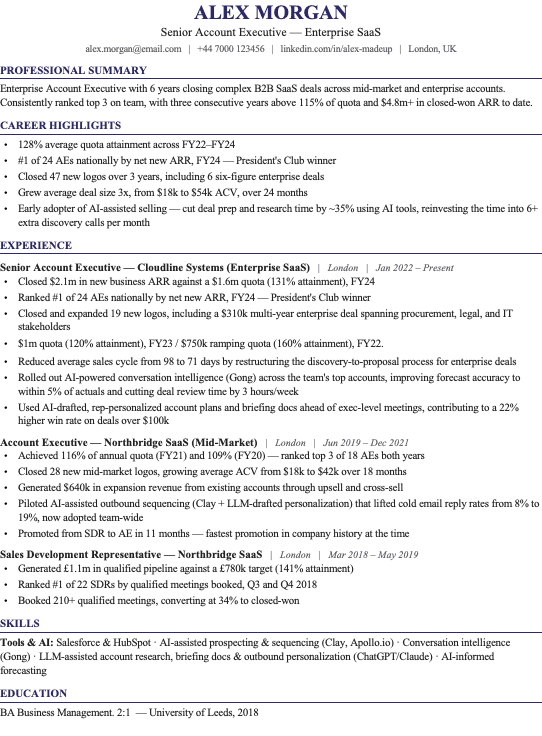
This article is going to show you exactly how to write a sales CV that hiring managers want to see (with a mock example below to copy).
Most sales CVs read like job descriptions. "Managed a portfolio of enterprise accounts." "Responsible for outbound prospecting and pipeline generation." "Worked closely with marketing to drive demand."
None of that tells a hiring manager anything.
Sales is one of the only functions in a business where performance is tracked, ranked, and published every single month, so your CV is the one document in the world where you have zero excuse for being vague. If you're in sales, your CV shouldn't read like a job description. It should read like a scorecard.
Here's how to build one that wins.
Lead with the number, not the noun
Every bullet on a sales CV should answer one question: so what happened? Swap the responsibility for the result.
Instead of "Responsible for new business sales into mid-market accounts," write something like: "Closed £1.2m in new business ARR across 34 mid-market logos, against a £900k quota (133% attainment)."
The formula is simple: what you did → the number it produced → the target it was measured against. If a bullet doesn't have a number in it, it's a task, not an achievement, and it belongs in the bin.
Quota attainment is your headline stat
Hiring managers in sales skim for one thing first: did this person hit target, and how consistently? Don't make them dig for it.
• State attainment as a percentage against quota, every year or half you can, e.g. "118% of annual quota (FY24), 109% (FY23)."
• If you've had a standout period, call it out on its own line — "President's Club, 2023" or "Q3 top performer" carries real weight.
• Show trend, not just a single good quarter. Consistent 100–110% beats one lucky 200% quarter, and hiring managers know the difference.
• If you missed a number one year, you don't need to hide the whole section — just don't lead with the miss. Lead with the years you crushed it.
Name the deals and logos (where you can)
"Closed several enterprise deals" tells a hiring manager nothing. "Closed and expanded [Logo], [Logo], and [Logo], including a $220k multi-year deal with [Logo]" tells them you can sell to the kind of company they're trying to sell to.
If you're under NDA or the logos are sensitive, you can still be specific about the shape of the win: sector, deal size, deal length, number of stakeholders, sales cycle length. "Closed a $180k, 14-month enterprise deal involving 6 stakeholders across procurement, legal, and IT" does the job just as well as naming the account.
Show where you ranked
If your CRM or sales ops team publishes leaderboards, mine them. Ranking is one of the most credible signals on a sales CV because it's relative, not self-reported - anyone can claim they "exceeded expectations," but "#2 of 38 AEs" is a fact someone else measured.
Good lines to steal:
• "Ranked #1 of 22 SDRs by qualified pipeline generated, Q1–Q4 2024"
• "Top 3 AE by net new revenue for 6 consecutive quarters"
• "Fastest rep to promotion from SDR to AE in company history"
A quick before/after
Before: "Managed outbound sales activity and helped grow the sales pipeline for the EMEA region."
After: "Generated £2.4m in qualified pipeline across EMEA through self-sourced outbound, converting at 28% to closed-won - ranked #2 of 15 AEs on new pipeline generated in FY24."
Same job. One of these gets you a callback.
The checklist before you hit send
• Every bullet has a number in it - activity, outcome, or both.
• Quota attainment appears somewhere near the top, not buried at the bottom of a role.
• At least one line shows scale (deal size, logo tier, sales cycle) and one shows relative performance (rank, percentile, award).
• You've cut every sentence that describes a responsibility with no outcome attached.
• It's skimmable in 20 seconds - because that's roughly what it'll get.
Your CV is the shortest, highest-stakes pitch you'll ever write. Sell yourself the way you'd sell a deal: with numbers, proof, and confidence in the outcome.
Here is a mock example CV for you all to follow (link here):